
diaspora and language
fuck valentine's day, here's a piece on immigration and culture

When my mama fell pregnant with me, her and my baba immigrated from Pakistan to Canada. I was born in a foreign hospital, away from any friends or family. When my mom fell ill after my birth, my dad slept on the floor of the hospital room with me on his chest. Their story was similar to that of many immigrants: they grew up well-off enough to be able to immigrate, and as soon as they got here, any privileges they may have held back home diminished. Mama had been a practicing lawyer and a journalist for a Christian newspaper back home. She had headed a non-profit aiding women in need. But here her degrees held no weight. To these people, her accented English undermined her intelligence, which led to years of under-employment. Baba, like so many other immigrant fathers, was forced into labour jobs. He worked in factories, drove trucks, did Uber. It consumed most of their lives to the point that, years later, when I expressed interest in getting a part-time job to help out around the house, they were reluctant.
A few months in, my dad’s parents— Amma and Abu ji, sent some money to buy a car. They would not be able to send enough for a home here, and my parents would be trapped in a cycle of basements and spare rooms until I grew older and they would begin to rent an apartment, but Ammi and Abu ji could send enough for their only son and his wife to buy a car. They bought a used Cadillac, and drove everywhere they could. Mama got her degree, and Baba did too. They worked their asses off. A year into them living there, Amma and Abu Ji immigrated too to help out.
Pakistani culture— most cultures, really, once you shed the shackles of western individualism— values community; family. Mama’s parents died when she was young,(my Nana ji’s death anniversary was last week, actually. He died when Ma was 20.) and Amma and Abu, Ba’s parents, were itching to meet their granddaughter (me!).
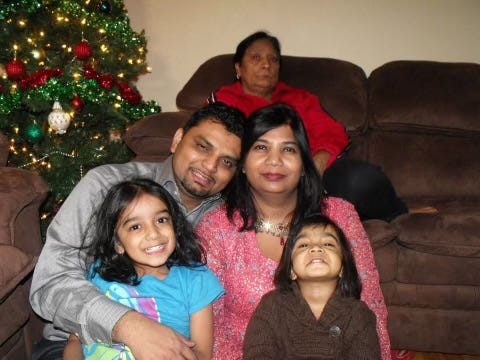
We spent years in that apartment. (Actually, for the first few years, it was a different apartment in the same building. When my sister was two, she almost fell off the balcony, and my parents moved us to the first floor. An unintended consequence of this was my affinity, growing up, for hopping fences) My parents had two children, both daughters. They loved us more than anything. My grandpa taught me how to sew, and my grandma taught me how to braid hair. I shared a room with my parents, and my younger sister shared with our grandparents. A few of my aunts and uncles moved nearby. Eventually, my parents saved enough to buy a house. They were building new houses in the area I now live in— on the other side of our city. We moved in eight years ago.
My parents spoke English when they moved here; a byproduct of hundreds of years of British colonialism. It was accented, sure, but they spoke it nonetheless. Having lived in Canada for 18 (or 19?) years now, Ba’s accent is barely noticeably. Mama gets self-conscious about hers from time to time, and I have recently had to lecture her on the fact that she is incredibly intelligent and wonderful and talented, and I look up to her more than anyone in my life. Her English is perfectly fine, and an accent does nothing to dampen that.
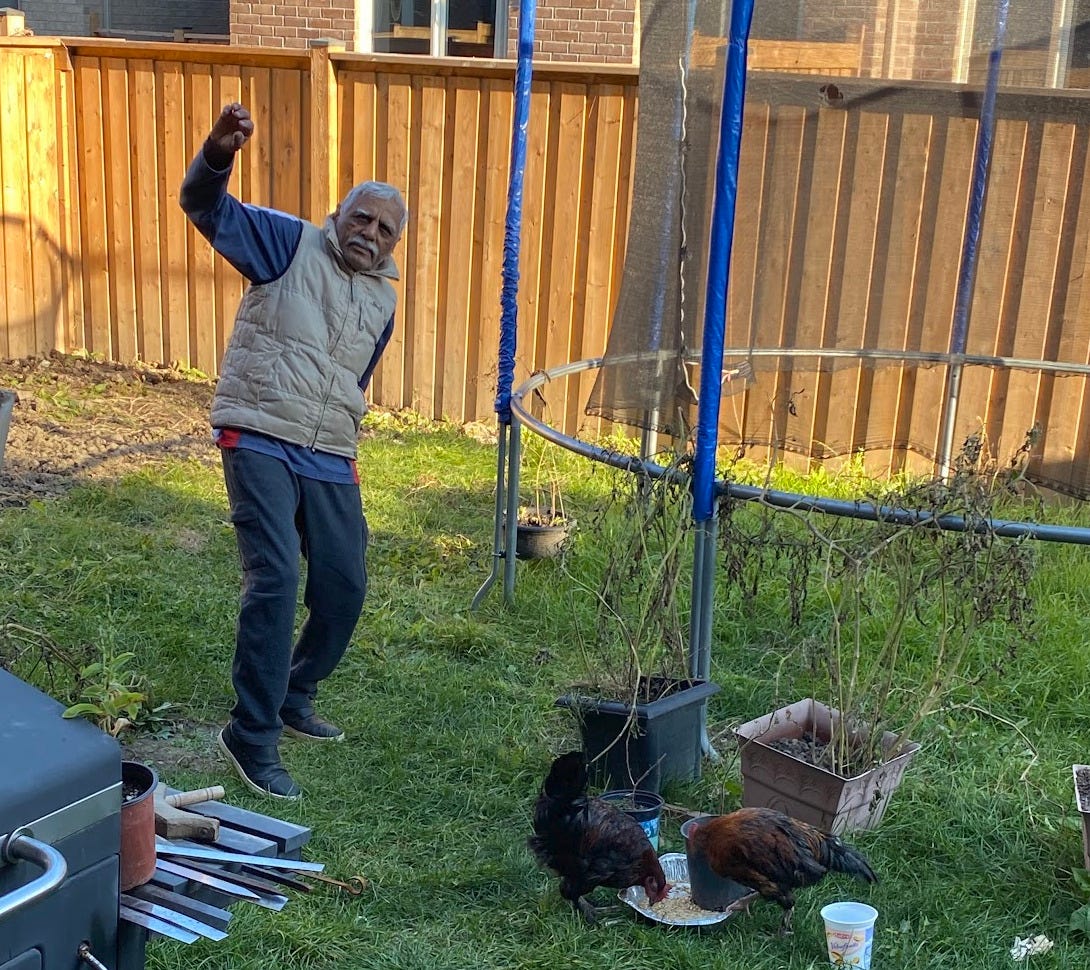
Abu ji spoke some English. He had a tendency to make friends with the other old men on our street, and as they were often of different backgrounds, they needed a common language. Abu ji spoke many languages: Urdu, Hindi, Punjabi, English, Arabi (he spent most of his adult life working in a printing press in Dubai and sending money back home to Amma and my Baba), Farsi. But he did not speak Creole or Italian or Spanish. English was the common denominator. He spoke English to talk to his friends and chat with our neighbours and make generally everyone adore him. He spoke Urdu to his family and the chickens he forced baba to let him keep in the backyard.
Amma, however, did not speak English. From what I remember, she only knew a few words and phrases. She spoke to my sister and I in Urdu. She scolded my baba in Punjabi.
I grew up here, never visited the homeland. (Flights were always far too expensive. We only visited for weddings and funerals— when we had to. And even then, we could only afford to send one or two people at a time. My grandparents and my parents went, obviously. I wish, often, that we’d had that sort of money back then. That we had it now. I want to see the place that, for all intents and purposes, should be another home for me.) I spoke Urdu well as a kid— when I was a toddler repeating phrases I learned at home. Once I got to school, however, Urdu stopped being the language I spoke most often. English became a main language of our household. Abu ji spoke to us in broken English. I begun speaking to my Amma less. When asked a question in Urdu, I would respond in English.
Of course, with disuse, my Urdu began to deteriorate. I began to rely more and more on English, dividing my household. I could no longer be close to my grandmother in words. There was a growing rift between myself and my grandfather. My parents were stuck trying to bridge the gap.
But they loved us. The four of them loved me and my little sister more than anything, and they were willing to try.
It started with Amma. She taught us how to cook. She oiled our hair, she had us sit in her lap as she watched her Hindi serials. She learned to love with her hands, instead of her words.
Abu split between words and actions. He mended my clothes. He washed and folded them. He complained loudly about the air of messiness that seemed to follow me everywhere, and he cleaned up after me. He asked about school. He walked with me everywhere. He took me places and smiled proudly when I made it to the top of a tree I had insisted on climbing.
I don’t quite remember when things changed. Maybe a little before my grandma died. I was 10 and all I knew was that she was sick. Amma was kind of my favourite person. She was kind and funny and her cooking was incredible. Everyone tells me, now, that I look exactly like she did when she was younger— except for the fact I have my grandpa’s nose. Once, at a diner in Montreal, she had held a butter knife to my dad’s throat and kindly motioned to the server to take a picture. Her arthritis got worse as she aged, and she stopped being able to love as well with her hands. It was my turn to bridge the gap. I began to talk to her in broken, accented Urdu. She understood, and responded in turn. I regret starting so late, but I think the timing must have been of God, because it was only afterwards that cancer caught up to her. For a few months, at least, I was able to love my Amma in her mother tongue. She died in the ICU, and she gave me the gold chain she always wore. (Which my younger sister now keeps).
I tried harder after that. My Urdu got better. Abu Ji was able to save English as the language he spoke with his friends, rather than with his family. I got to a point where the jokes I made in Urdu landed— the first time Abu laughed at one of my jokes, I was on cloud nine all day. I had not noticed, before, how far the language barrier had stretched. By the time he passed away, I was conversing with him almost exclusively in Urdu.
I noticed more and more just how much speaking in Urdu changed things. My parents and I fought less— misunderstandings relieved. They were proficient, yes, but they were not comfortable. And my job as the eldest daughter is to do what I can to let my mama and baba, who sacrificed so much for me, be comfortable. So we speak in Urdu now (at least with Ma. Ba prefers English sometimes; he’s grown into it). Aunties and Uncles like me more— the older men at my church are deeply impressed every time I give a speech in Urdu, or even carry a conversation. They are so proud. The way they smile when they greet me makes me feel things I couldn’t begin to put into words.
Urdu, for me, is potent. It carries meaning. I don’t use it when I express myself— I can’t. It carried too much weight.
But I literally can’t.
I learned my native language the way many diaspora kids learn their native languages: through listening. We couldn’t afford a tutor or classes that would teach me things like literacy, and when I was young enough for my parents or grandparents to have taught me, I was trying so desperately to be accepted by my white peers that I wouldn’t have even wanted to. So I am left with a disconnect. I cannot read the poems my Ma wrote when she was my age. I can’t keep any of Abu ji’s scribbled notes as a keepsake. Fuck, I can’t tell the differences between the labels for the daal or the chicken my mom keeps in the freezer. I can’t read the classics of my people— the translation would not do it justice. I’m left with spoken word. with songs, with conversation. I am left with a resolve to teach myself, and no idea where to start. I want to be able to write in Urdu. I want to leave mama notes— telling her I love her, reminding her of things as her memory gets worse. I want to read poetry. I want to write. I want to shoulder the weight of my mother tongue, and because of that disconnect I am not able to.
I plan to take a course or two. My mother was a writer, I am a writer. We are Pakistani. I want to be able to read in my mother tongue. I will bridge the gap once more, just as I did when I was younger.
Amma would have liked who I have become. She would have liked the jhumkas I wear everyday and she would have said her shalwaar kameez looks better on me. We would be able to talk. Abu ji would have been so proud to see me graduate. He would have loved the way I speak with the elders at church. Bishop saab reminds me of him quite a bit. Mama is proud of me. She tells me as much any chance she gets. She says it in English, in Urdu. Baba is too. My language, my culture, bring me closer to my family.
These stories always make me stare at a wall and sigh
this is so so so beautiful, the love in your family. also very relatable for me unfortunately, yes even though I can speak write and read Urdu, it's not nearly as good as my peers
thank you for writing, loved it